
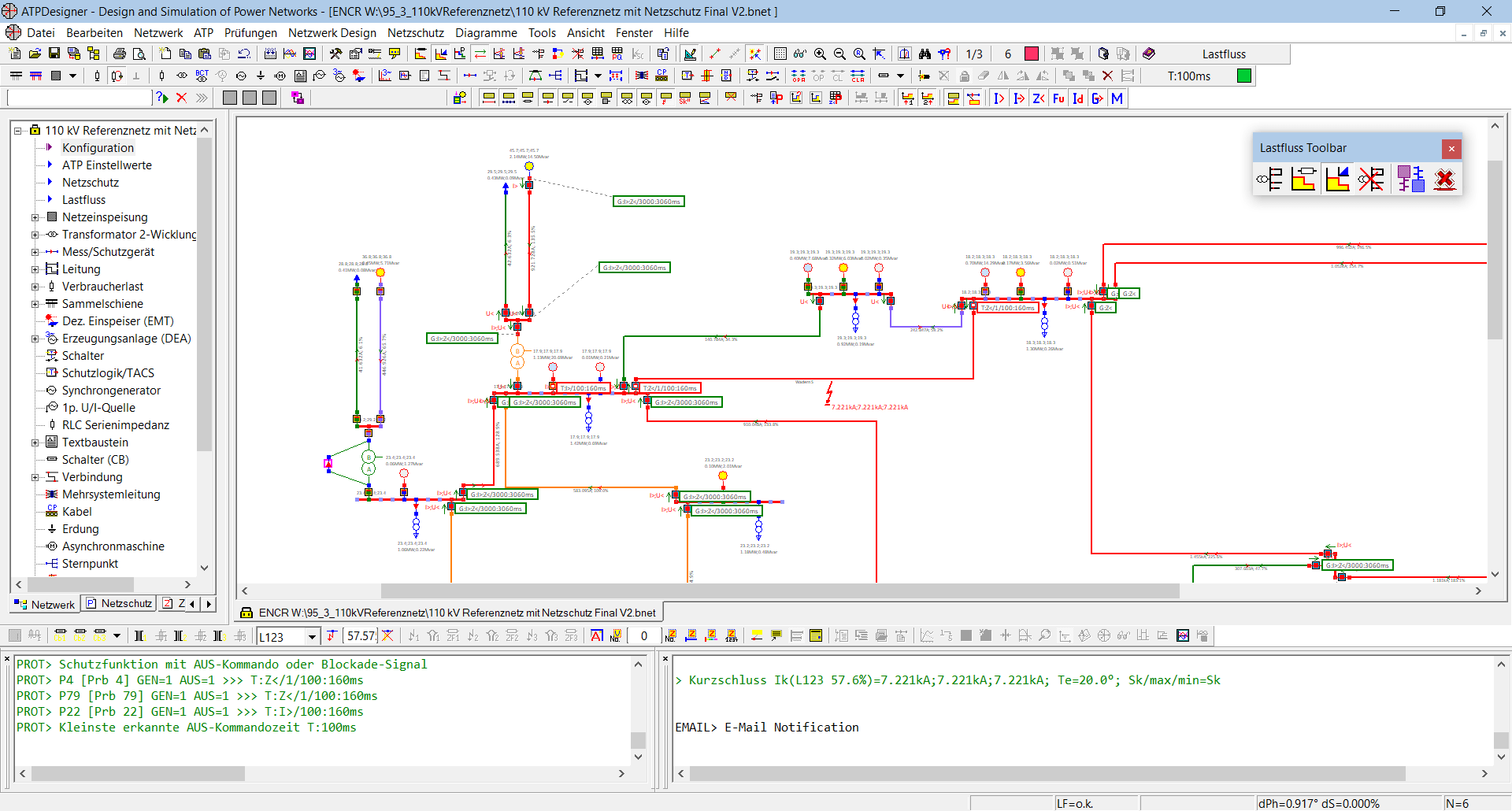
Short-Circuit Calculation in 110-kV-Power Grid
Overview about ATPDesigner
A network calculation program is generally understood to be software that enables the calculation of electrical quantities such as voltages, currents and power in electrical power grids of all voltage levels and any topologies. The network calculation will be processed based on numerical models that are derived from the physical properties of the equipment used in electrical power grids, e.g. transformers or lines. For the calculation of the transients in power grids, models based on differential equations of higher order are used, which are numerically solved by integration methods. The results are time histories of the physical quantities such as v(t) or i(i).
If the aspect of network dynamics is not of interest, it is sufficient to use a Load Flow Calculation or extended load flow calculation. Starting from a physically steady-state network condition (i.e. all dynamic network processes have completely decayed), voltages, currents, etc. can be calculated at any network nodes against reference potential (usually earth) or between any two network nodes as complex phasors. The complex phasors indicate either the magnitude (e.g. in V or A) and the absolute phase angle in degrees or real and imaginary parts in the sense of a complex number. One prerequisite for a load flow calculation is a constant mains frequency, which does not necessarily have to be the nominal frequency.
Load Flow Calculation
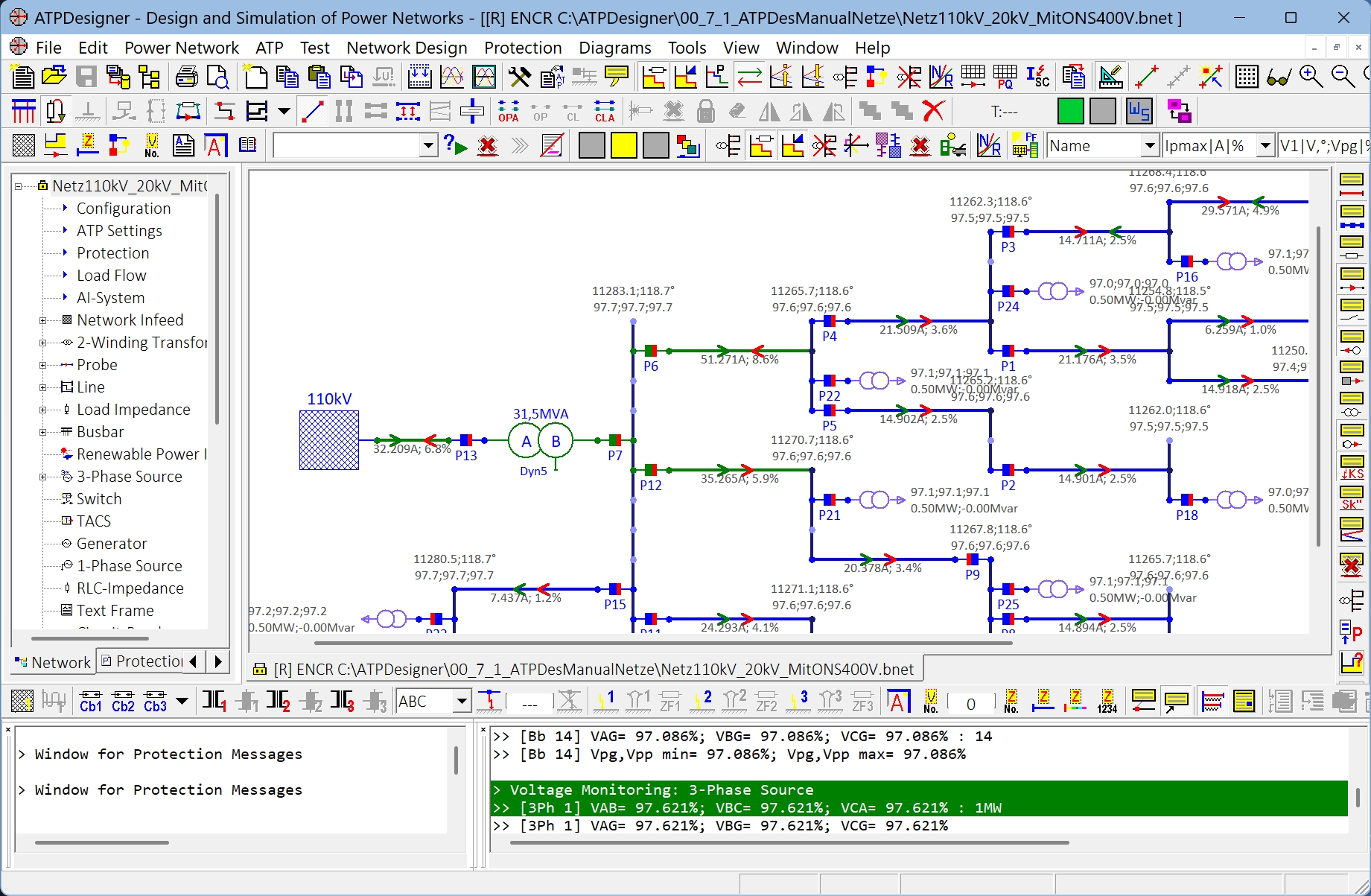 If the simulation of transients is not of interest, it is sufficient to use the load flow calculation to calculate the steady-state of the power grid. The results of the load flow calculation are the complex phasors of node-voltages V and branch-currents I as well as load flow of the active power P and the reactive power Q.
In order to recognize the full range of functions, methods and models of the network calculation program ATPDesigner, the ATPDesigner manuals shall be studied.